How to Tailor Your Resume for Every Job Application (Without Starting From Scratch)
You’ve heard it a thousand times: “tailor your resume to the job description.” Great advice. Terrible execution guidance. Nobody tells you how to do it without spending an hour per application rewriting everything from scratch.
The result? Most job seekers either send the same generic resume to every opening (and wonder why they hear nothing back) or burn out after customizing five applications and give up. There’s a better way.
Why Generic Resumes Get Ignored
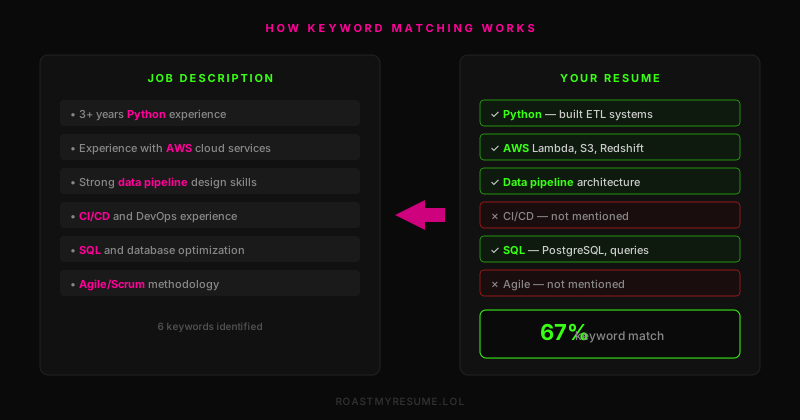
Let’s start with what happens to your resume once you hit “Submit.” At most mid-to-large companies, it goes through an applicant tracking system (ATS) before any human sees it. The ATS parses your resume, extracts keywords, and scores how well you match the job description.
If you’re applying for a “Data Engineer” role and your resume says “Software Developer” with no mention of data pipelines, ETL, or warehouse tools — the ATS may rank you below candidates who did use those exact terms, even if you do that work daily.
A 2023 Jobscan study found that resumes with a 65%+ keyword match rate are 2.5x more likely to get past ATS screening. The threshold isn’t perfection — it’s relevance. And relevance requires tailoring.
The 80/20 Method: What to Customize (and What to Leave Alone)
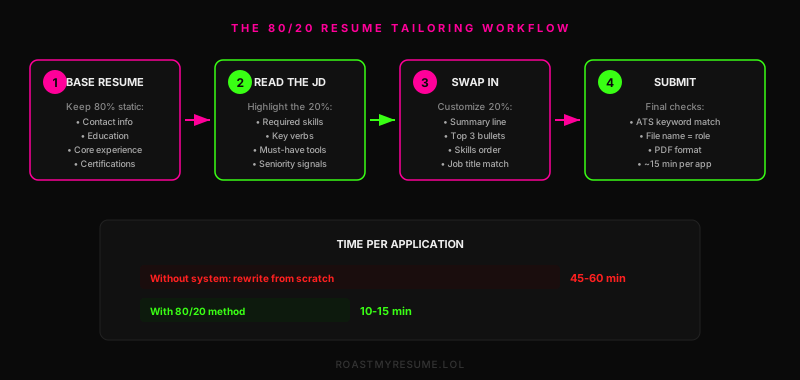
Here’s the system that lets you tailor meaningfully without burning out. The idea is simple: 80% of your resume stays the same. You only change 20% for each application.
The 80% that stays static
- Contact information — name, email, phone, LinkedIn URL, portfolio link
- Education — degrees, institutions, graduation dates
- Core experience structure — company names, dates, job titles (with exceptions below)
- Certifications — AWS, PMP, CPA, etc.
- Most bullet points — the majority describe real work that doesn’t need rewording
The 20% you customize
- Summary/headline — rewrite 1–2 lines to mirror the role’s language
- Top 3 bullet points — surface the most relevant ones first under your current/recent role
- Skills section order — reorder to put the JD’s priority skills first
- Job title (if reasonable) — if your internal title was “Associate II” and the role is “Marketing Analyst,” adjust if your actual work matched
- Keyword injection — add specific tools, methodologies, or frameworks mentioned in the JD
Step-by-Step: Tailoring a Resume in 15 Minutes
Here’s the exact process. Once you have your base resume, each application should take 10–15 minutes, not an hour.
Step 1: Read the job description (3 minutes)
Don’t skim. Read the entire thing, but highlight these specific elements:
- Hard skills and tools mentioned (especially in “Requirements”)
- Action verbs the company uses (“drive,” “build,” “own”)
- Seniority signals (“mentor junior team members” vs. “work under supervision”)
- Industry-specific jargon (“full-cycle recruiting,” “revenue operations”)
- The top 3 responsibilities listed — these are what they care about most
Step 2: Update your summary (2 minutes)
Your summary should read like a direct response to their posting. Don’t copy it — mirror it.
See the difference? The tailored version uses the exact tools and framing from a real data engineering JD.
Step 3: Reorder your bullets (5 minutes)
This is where most of the tailoring value comes from. You don’t need to rewrite bullets — you need to reorder them so the most relevant ones appear first.
Recruiters spend 6–7 seconds on an initial scan. If your top 3 bullets under your current role match the JD’s top 3 requirements, you’ve won the scan.
Also consider lightly rewording one or two bullets to incorporate the JD’s exact terminology. If they say “data orchestration” and you wrote “workflow scheduling,” update it. Same concept, their words.
Step 4: Adjust your skills section (3 minutes)
Your skills section should be a mirror of the JD’s requirements, listed in the same priority order. If the job lists “Python, SQL, Spark, Airflow, AWS” in that order, your skills section should open with those same tools — assuming you genuinely have them.
Don’t list skills you don’t have. Getting past the ATS only to bomb a technical interview wastes everyone’s time, including yours.
Step 5: Final check (2 minutes)
- Does your resume mention at least 60–70% of the hard skills in the JD?
- Are your top 3 bullets relevant to their top 3 priorities?
- Is the file name professional? (FirstName_LastName_DataEngineer.pdf — not resume_final_v3_FINAL.docx)
- Is it saved as a PDF? (Unless they specifically request .docx)
The Master Resume System
Before you can tailor efficiently, you need a master resume — a document that includes everything you’ve ever done. Every role, every bullet, every project, every certification. This isn’t something you send to anyone. It’s your personal archive.
From this master document, you create 2–3 base versions targeting different types of roles. For example:
- Version A: Backend Engineering roles — emphasizes system design, APIs, databases
- Version B: Data Engineering roles — emphasizes pipelines, ETL, cloud infrastructure
- Version C: Engineering Management roles — emphasizes team leadership, hiring, process improvement
When a new job opens up, you grab the closest base version and apply the 20% tailoring. Total time: 10–15 minutes. Compare that to rewriting from scratch every time.
What ATS Actually Looks For
Let’s demystify the “ATS keyword matching” fear. Modern ATS systems (Greenhouse, Lever, Workday, iCIMS) don’t just do simple keyword matching. They also consider:
- Context — “Python” appearing in your skills section and in a bullet point carries more weight than just listing it once
- Recency — skills used in your most recent role matter more than those from 8 years ago
- Exact match vs. synonym — most ATS understand that “JavaScript” and “JS” are the same, but don’t count on it. Use the exact term from the JD
- Required vs. preferred — some ATS weight “required” qualifications higher than “nice to have”
The goal isn’t to game the system. It’s to accurately represent your experience using the same language the employer uses. That’s not dishonest — it’s communication.
Common Tailoring Mistakes
1. Copy-pasting the job description into your resume
Recruiters and increasingly ATS systems can detect when you’ve literally copied JD language verbatim. Use the same keywords, but put them in the context of your actual accomplishments.
2. Lying about skills you don’t have
If the JD requires “5 years of Kubernetes experience” and you’ve never touched it, don’t add it. Technical interviews exist for a reason. You’ll waste your time, the interviewer’s time, and potentially burn a bridge at that company.
3. Only tailoring the skills section
The skills section alone isn’t enough. Recruiters and ATS both look for keywords in context — within your bullet points, your summary, and your role descriptions. A keyword in a bullet point about a real achievement is worth 10x more than the same keyword in a comma-separated list.
4. Sending the same resume to similar roles
Two “Product Manager” roles at different companies can have wildly different requirements. One might emphasize technical specs and API design, while another focuses on go-to-market strategy and customer research. Read each JD individually.
5. Over-tailoring
If you’re changing more than 30% of your resume per application, you’re either applying to roles that don’t match your background, or you’re overthinking it. The 80/20 rule exists for efficiency.
Industry-Specific Tailoring Tips
Software Engineering
Match the tech stack exactly. If they say “React” don’t write “JavaScript frameworks.” Say “React.” List languages and tools in the same order the JD uses. Mention specific versions if relevant (Python 3.11, Node 20).
Marketing
Mirror their channel focus. If the role is “Growth Marketing,” emphasize CAC, conversion funnels, and experimentation. If it’s “Brand Marketing,” lead with campaign reach, brand awareness, and creative strategy. Same person, different framing.
Finance
Match their modeling tools (Excel, Bloomberg, Capital IQ, Python). Lead with relevant deal types, asset classes, or regulatory frameworks. FP&A roles care about forecasting accuracy; investment banking roles care about deal flow and valuations.
Sales
Mirror quota language. If they say “exceeded quota by X%,” your resume better include quota attainment percentages. Match their CRM (Salesforce, HubSpot) and any specific sales methodologies (MEDDIC, Challenger, SPIN).
Tracking Your Tailored Versions
Once you’re applying to multiple jobs, version control matters. Here’s a simple system:
- Name files: LastName_CompanyName_RoleTitle.pdf
- Keep a spreadsheet with: Company, Role, Date Applied, Resume Version, Status
- Save a copy of every JD you apply to — they get taken down once the role is filled
- Note which version performed best (got callbacks) and use it as a reference
The Bottom Line
Tailoring your resume isn’t about creating a new document for every application. It’s about having a system that lets you customize 20% of a strong base resume in 15 minutes.
The biggest mistake isn’t sending a slightly imperfect resume — it’s sending a completely generic one. Even small tweaks to your summary, bullet order, and skills list can be the difference between getting filtered out by ATS and landing in a recruiter’s “maybe” pile.
And “maybe” is where interviews come from.
Want to see how well your resume matches?
Upload it for a free AI roast. We’ll score every section, flag missing keywords, and tell you exactly what’s weak.
Roast My Resume — Free →