Should Your Resume Be One Page? The Real Answer
“Keep your resume to one page.” You’ve heard it from career counselors, Reddit threads, and that one uncle who hasn’t applied for a job since 2003. It’s one of the most commonly repeated pieces of career advice — and it’s only sometimes right.
The truth is, resume length is a decision, not a rule. It depends on how much experience you have, what kind of role you’re targeting, and whether your second page actually adds value or just pads your ego. Here’s how to figure out which camp you fall into.
Where the “One Page Rule” Came From
The one-page resume convention started in an era when resumes were literally printed on paper and physically handed to hiring managers. Brevity was a practical necessity, not a strategic advantage.
Then the internet happened. Then applicant tracking systems. Then LinkedIn profiles that have no page limit at all. The job market changed dramatically, but the advice stayed frozen in time.
Does that mean the one-page rule is useless? No. It’s still excellent advice for a specific group of people. The problem is when it’s applied universally to everyone, including senior engineers with 15 years of experience and published researchers with 40 conference papers.
When One Page Is the Right Call
If any of the following describe you, stick to one page. No exceptions.
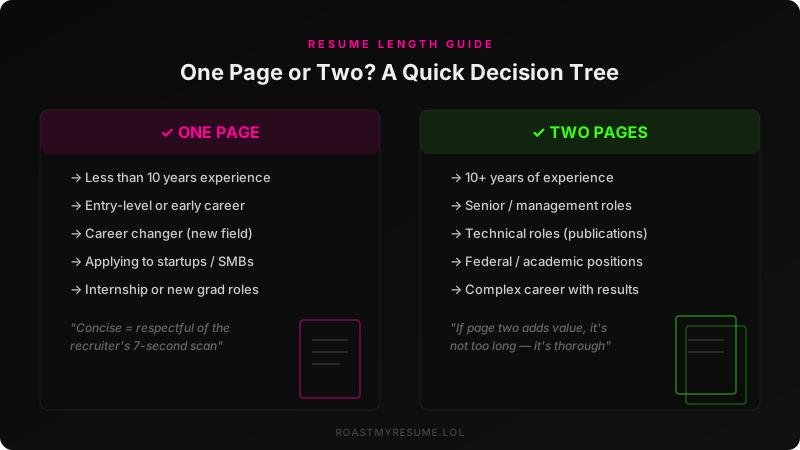
- Less than 10 years of experience. You simply don’t have enough relevant content to justify two pages. If your resume is two pages at this stage, you’re including filler.
- Entry-level or new graduate. Internships, projects, and coursework can all go on a resume — but they don’t need two pages to communicate.
- Career changer. When you’re pivoting industries, only your transferable experience matters. Your 7 years in an unrelated field gets summarized in 2–3 bullet points, not a full page.
- Applying to startups or small companies. Lean organizations value brevity. A two-page resume signals that you don’t know how to prioritize.
- The job posting says “one page.” This one’s obvious, but people still ignore it. Follow the instructions.
The recruiter perspective
A recruiter using an ATS spends an average of 6–7 seconds on an initial resume scan. That scan typically covers the top third of page one: your name, title, most recent role, and a few bullet points. Whether your resume is one page or three, those 7 seconds don’t change. But a concise one-page resume signals that you respect the reader’s time — and that you can distill your value proposition.
When Two Pages Is Perfectly Fine
Two pages isn’t “too long.” It’s the right length when every line on page two earns its place. Here’s when that applies:
- 10+ years of relevant experience. If you have a decade of progressively responsible roles, compressing them into one page means cutting achievements that could land you the interview.
- Senior, director, or VP-level roles. At this level, employers expect to see leadership scope, budget ownership, team size, and strategic impact. That takes room.
- Technical roles with publications or patents. Software engineers, researchers, and scientists often need space for technical skills, projects, and published work.
- Federal jobs and academic CVs. Government applications (USAJOBS) explicitly require detailed, multi-page documents. Academic CVs can run 5+ pages.
- Roles where depth matters. Consulting, legal, and medical positions often require demonstrating depth of expertise across multiple engagements.
Two pages if you have 10+ years AND every bullet on page two is relevant to the target role.
Never three pages. (Unless it’s an academic CV or a federal application.)
The “Half-Page Two Problem”
Here’s the worst-case scenario that nobody talks about: a two-page resume where page two is half empty. Maybe it has your education and a few skills at the top, then a vast expanse of white space.
This is worse than a one-page resume. It signals one of two things to a recruiter:
- You couldn’t edit, so you didn’t try
- You’re padding your resume to look more experienced
If your resume goes to page two, make sure page two is at least two-thirds full. If it’s not, either add meaningful content or cut back to one page.
How to Cut Your Resume Down to One Page
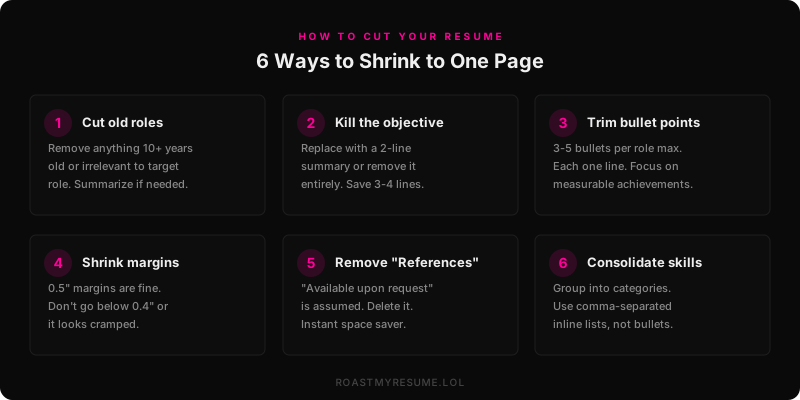
If you’re over one page and shouldn’t be, here are six strategies that work — ranked by how much space they typically save.
1. Remove old or irrelevant roles
Anything older than 10–15 years is unlikely to be relevant. That summer job from college? Gone. Your first role that has nothing to do with your current trajectory? Summarize it in one line or remove it entirely.
• Prepared beverages for customers in a fast-paced environment
• Maintained cleanliness standards and restocked supplies
• Handled cash register transactions accurately
Unless you’re applying for a food service management role, this is dead weight. Remove it and reclaim three lines.
2. Kill or shrink your objective/summary
A 4-line objective statement eats valuable space. Either replace it with a tight 2-line summary or remove it entirely. Your experience section should speak for itself.
3. Trim bullet points to 3–5 per role
Each bullet point should be one line, two max. If you have 8 bullets under a single role, ask yourself: which 3–4 are the most impactful? Keep those. Make sure they include numbers.
4. Adjust margins and font size
You can safely reduce margins to 0.5 inches on all sides. Font size can go to 10pt for body text without readability issues. Don’t go below 0.4” margins or 9.5pt font — it looks desperate and ATS parsers may have trouble.
5. Delete “References available upon request”
This line adds zero value. Every recruiter already assumes you’ll provide references when asked. Delete it and reclaim a line.
6. Consolidate your skills section
Instead of a bulleted list of individual skills, use comma-separated categories on a single line. This is also better for ATS parsing.
• Microsoft Excel
• PowerPoint
• Google Analytics
• Salesforce
• Slack
What About ATS Systems?
ATS software doesn’t care about page count. It parses your entire document regardless of length. A one-page resume doesn’t score higher than a two-page resume. What matters is keyword density and relevance — not page count.
That said, a bloated two-page resume filled with irrelevant keywords and outdated roles can actually hurt your ATS score by diluting your keyword-to-content ratio. A focused one-page resume with targeted keywords will often score higher than a padded two-pager.
Quick Decision Framework
Ask yourself these three questions:
- If I removed everything on page two, would I still get an interview? If yes, it should be one page.
- Is every bullet point on page two directly relevant to the job I’m applying for? If no, cut or rewrite.
- Is page two at least two-thirds full? If no, either add substance or consolidate to one page.
Industry Differences That Matter
Tech
Most tech companies prefer one-page resumes for individual contributors and two pages for senior/staff+ engineers. FAANG companies explicitly prefer concise resumes. If your resume is over two pages for a tech role, something is wrong.
Finance & consulting
Investment banking and consulting firms strongly prefer one-page resumes, even for experienced hires. Brevity is considered a skill. If you can’t summarize your career on one page, you can’t summarize a deal memo or deck, either.
Healthcare & academia
Clinical resumes and academic CVs are the exception. These often run 3–10 pages and include publications, grants, clinical rotations, and teaching experience. The “one page rule” doesn’t apply here at all.
Government
Federal resumes (USAJOBS) require extremely detailed descriptions of duties, hours worked, supervisor information, and more. These are typically 3–5 pages. Trying to fit a federal resume on one page will get you rejected.
The Bottom Line
The question isn’t “should my resume be one page?” The question is: “does every line on my resume earn its place?”
If you’re under 10 years in, keep it to one page. If you’re over 10 years and every bullet on page two is relevant and quantified, use two pages. If you’re anywhere in between, err on the side of shorter.
Nobody ever lost an interview because their resume was too concise. Plenty of people have lost them because their resume was too long and unfocused.
Not sure if your resume is the right length?
Upload it for a free AI audit. We’ll tell you if it’s too long, too short, or missing the content that actually matters.
Roast My Resume — Free →